Reading time: 2’
The combination coral and women does not surprise us, but the centrality of the female role in the spread of this beautiful stone is, for many, unknown.
Let’s take a temporal leap of two hundred years to discover how the story of coral is, most of all, a story of women.
HOW IT ALL BEGAN
In 1805 the Marseilles merchant Paolo Bartolomeo Martin made a request to the King of Naples Ferdinand IV of Bourbon: to open a coral factory in Torre del Greco.
Martin identified great potential in the Neapolitan city, implemented even more by a series of favourable conditions that he was able to skilfully exploit. A developed coral fishing industry – together with the Bourbon will to develop the coral industry and spread coral fashion throughout Europe – made Torre del Greco a fertile ground particularly suitable for this type of industry.
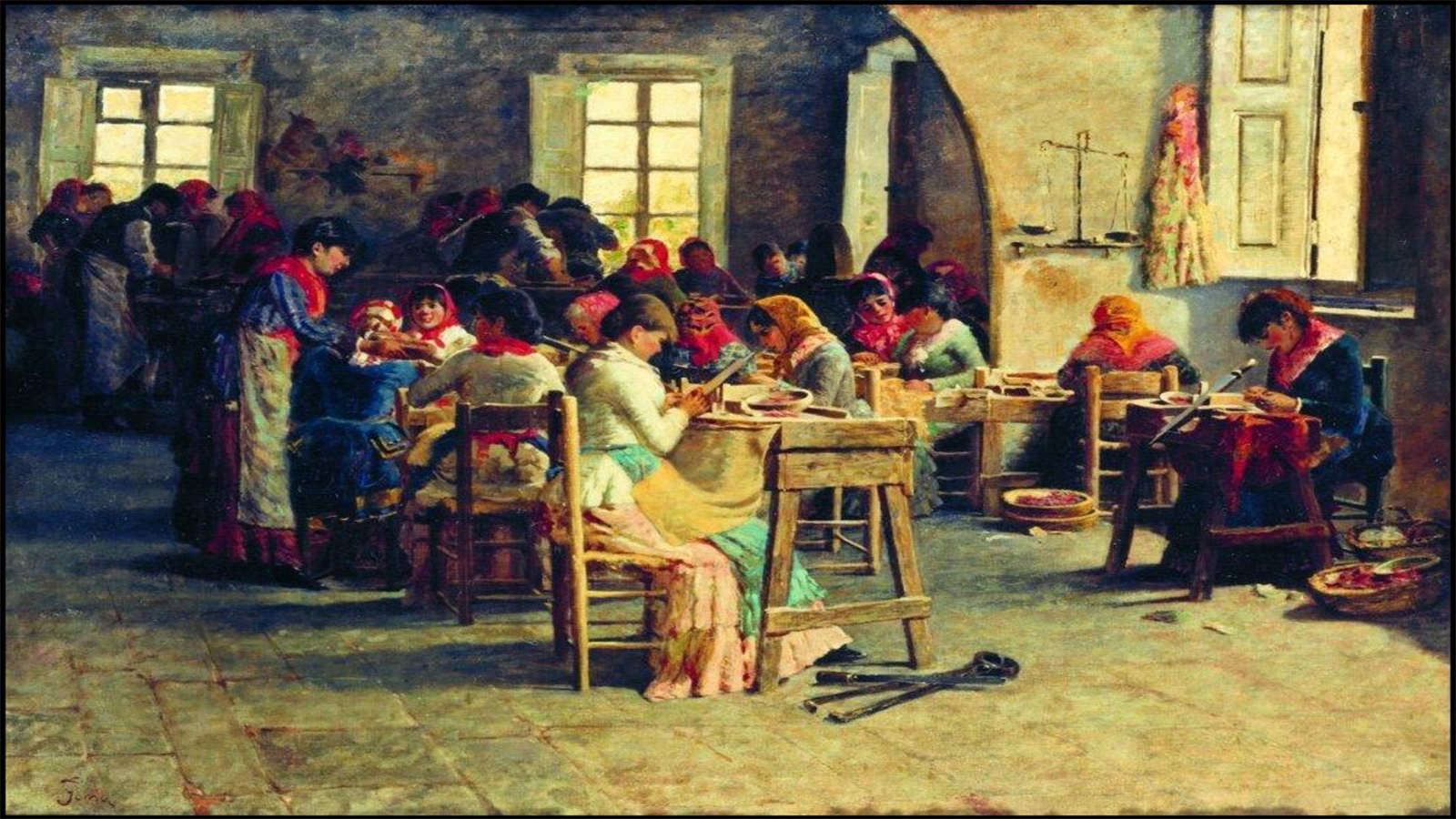
The proposal was accepted: the same year the Marseillais obtained a ten-year mandate to start a coral production factory, on the condition of employing mainly women so that, as art historian Caterina Ascione tells us, they could lead “a more dignified existence“.
STORY OF WOMEN
The reasons for this particular “clause” are attributable: first, to the manual skill that they possessed in the various stages of coral processing, particularly in the piercing and cutting of branches; secondly, to the fact that they represented the only workforce available at the time, as the majority of men were engaged in fishing.
In fact, the absence of husbands for long periods of time often condemned these women to conditions of extreme poverty and degradation, so that in many cases, to provide for the family, they were forced to prostitute themselves or to resort to usurers.
The advent of Martin’s factory represented the first step towards the emancipation of women from Torre del Greco and, in general, from the South. A series of “rights” were recognized for women, such as the possibility of being able to work from home and to reduce working hours in order to care for their children – but above all, perhaps for the first time in the history of the city, women acquired the tools to provide for their own economic independence.
THE RIGHT HISTORICAL VALUE
Women have long been the symbol of coral working. Some estimates of the late 1800 attest, that 3/4 of the workforce in the coral industry was female.
Yet, few people know the importance of the role of women within the social and economic fabric of Torre del Greco. With this article, Moni Lisa wants to preserve and shed light on the valuable historical legacy created by these women.
Did you know about the story behind women and coral? To find out more and discover other coral curiosities, follow us on our blog