
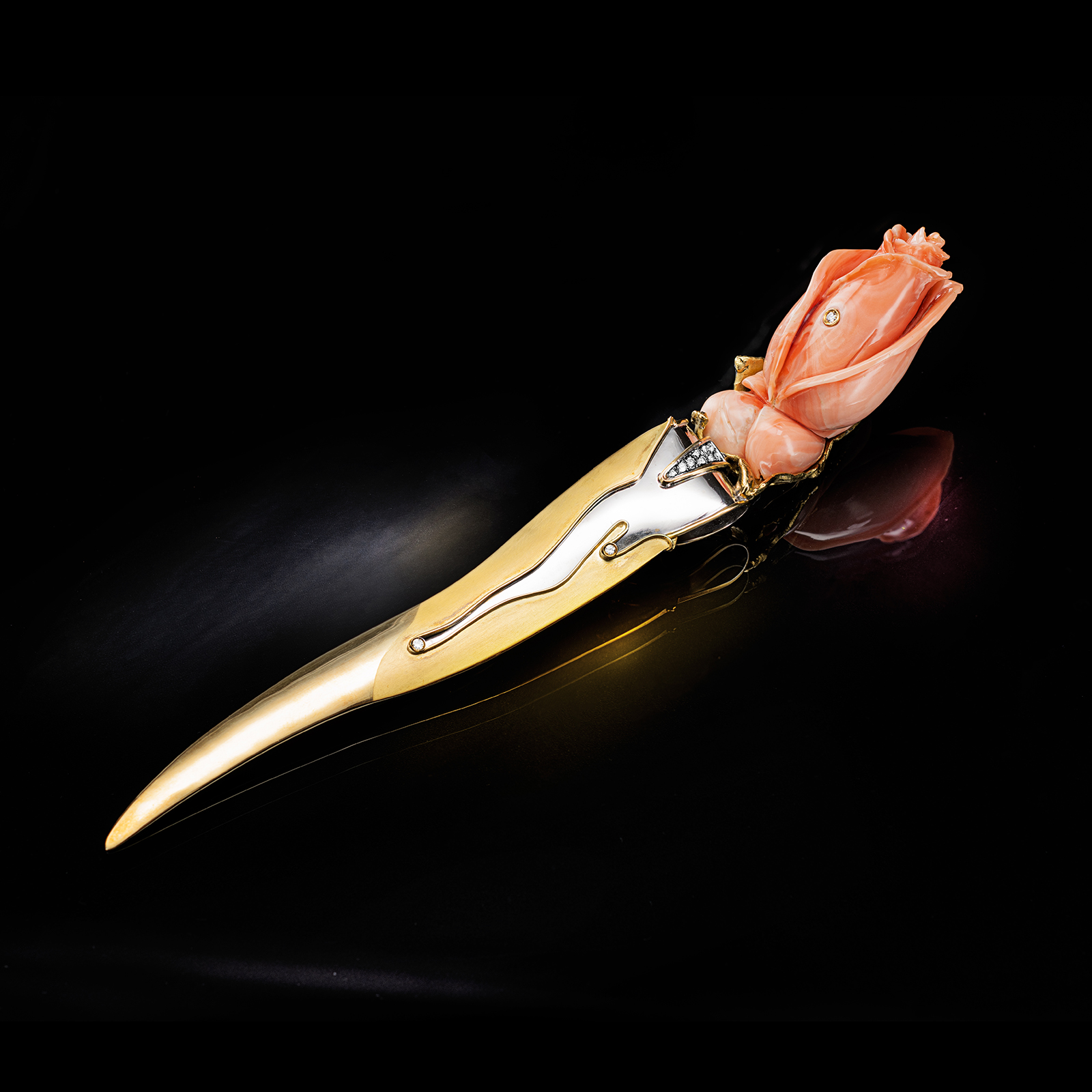
[vc_row full_width=”stretch_row_content_no_spaces” css=”.vc_custom_1628150628814{background-color: #f7f7f7 !important;}”][vc_column width=”1/2″][vc_gallery interval=”0″ images=”127410,127411″ img_size=”1600×1600″ onclick=”img_link_large”][/vc_column][vc_column width=”1/2″][vc_empty_space height=”200px” el_id=”nomobile”][vc_custom_heading text=”Paper knife with pink rose” font_container=”tag:h2|font_size:40px|text_align:center|color:%230a0a0a” use_theme_fonts=”yes”][vc_empty_space height=”25px”][vc_column_text css=”.vc_custom_1638524630823{margin-right: 15px !important;margin-left: 15px !important;}”]
Pacific Salmon Coral Carving with 18 Kt Yellow Gold and GVVS Diamonds.
code: 4874
[/vc_column_text][vc_empty_space height=”25px”][sober_button align=”center” el_class=”informazioni” label=”Request information” link=”url:https%3A%2F%2Fmonilisa.blueboxcommunication.it%2Fen%2Fcontact-us%2F|title:Contattaci”][/vc_column][/vc_row][vc_row full_width=”stretch_row_content” css=”.vc_custom_1628148678605{background-color: #f8f8f8 !important;}”][vc_column][vc_empty_space height=”25px”][vc_tta_tabs color=”white” active_section=”1″ css=”.vc_custom_1628148659838{background-color: #f8f8f8 !important;}”][vc_tta_section title=”Designer” tab_id=”1627375066984-9b1ba24d-38cd”][vc_column_text css=”.vc_custom_1635239162920{padding-right: 10% !important;padding-left: 10% !important;}”]
VINCENZO ABBAGNANO
Of Neapolitan origins, Abbagnano is a goldsmith who creates jewels with corals, turquoises, and cameos. His style, transversal in shapes and structures, stands out for elegance and originality. Thanks to his working experience as a professor at Istituto d’arte di Sorrento, Abbagnano receives everyday inspiration to reinvent his art and to create new combinations with elements of all the types.
GUGLIELMO GANERI
Leading figure in the field of coral and turquoise art, Guglielmo Caneri has experimented over the year different styles and motifs, portraying subjects of various kind. Moreover, he dedicates himself to the restoration of the coral ornaments of religious objects and relics of the antique goldsmith art. His works are now exhibited in different private collections and museums.
[/vc_column_text][/vc_tta_section][vc_tta_section title=”Materials” tab_id=”1627375066993-9e5ffd04-d782″][vc_column_text css=”.vc_custom_1634809902540{padding-right: 10% !important;padding-left: 10% !important;}”]
PACIFIC CORAL: “CORALLIUM ELATIUS”
According to the legend, the coral was born from the blood of the beheaded Medusa, that coloured and petrified the seaweeds upon which Perseo had laid/ placed her head, turning them into coral. However, the science has another explanation: the coral is the calcareous secretion produced by little octopus communities, with support and protection function. These secretions, blending together, result in colonies.
In jewellery, the most appreciated corals, both for their value and beauty, are those from the Mediterranean Sea and the Pacific Ocean.
The coral coming from the Pacific Ocean can be divided into three subcategories: Corallium Elatius, Secundum and Japonicum.
Elatius coral stands out for the size of its branches. It occurs in different shades of colour: from Momo in salmon and peach colour, up to the rarest Angel skin, in light pink. The coral in angel skin, due to the rarity and uniformity of its colour, is the finest and most valued among the coral varieties.
18 Kt GOLD
Pure gold, as present in nature, is a malleable material. So, in order to be used in jewellery, it must be alloyed with other metals. As a consequence, gold can have different colorations: yellow gold requires additional alloys like brass, zinc and silver; in white gold, on the other hand, are used alloys of brass (in reduced amount compared to yellow gold) and palladium.
DIAMOND
From Greek Adamas, unconquerable, the name diamond refers to the hardness of this precious gem. Diamond is the crystalized form of carbon, formed below the Earth’s surface over billions of years; indeed, it needs high pression and temperature to crystallize.
Diamond is always been considered a symbol of love: the roman emperor Maximilian I started this tradition by gifting his beloved Mary of Burgundy with a diamond ring.[/vc_column_text][/vc_tta_section][/vc_tta_tabs][/vc_column][/vc_row][vc_row][vc_column][vc_column_text]
[/vc_column_text][/vc_column][/vc_row]